The Core Principles of High Reliability Organizations
 Athenatus Ricky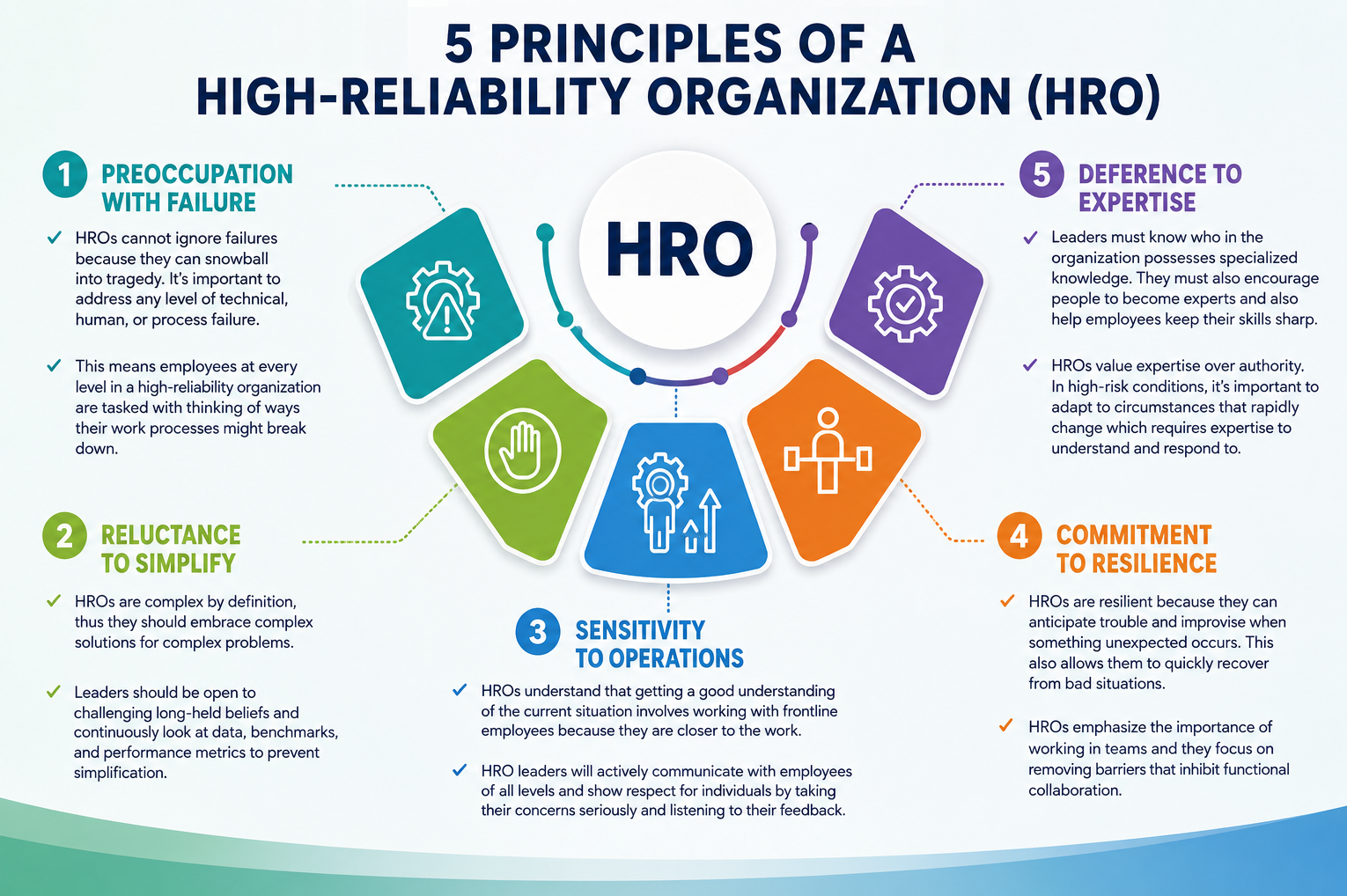
Introduction
Modern industries operate in environments where a single mistake can result in catastrophic consequences involving loss of life, environmental destruction, financial collapse, operational shutdown, or severe reputational damage. Industries such as aviation, healthcare, nuclear power, oil and gas, firefighting, military operations, chemical manufacturing, transportation, and energy production all function within highly complex and hazardous systems where the margin for error is extremely small.
Despite these risks, some organizations consistently achieve exceptional safety and operational performance over long periods without experiencing major disasters. These organizations are known as High Reliability Organizations, commonly referred to as HROs.
A High Reliability Organization is an organization that operates in high risk and complex environments while maintaining an outstanding level of safety, reliability, and operational consistency. These organizations recognize that failure is always possible, but they continuously develop systems, leadership approaches, communication structures, and operational disciplines designed to detect, prevent, manage, and recover from failures before catastrophic outcomes occur.
Unlike organizations that react only after incidents happen, HROs maintain a constant state of awareness, preparedness, learning, and improvement. They understand that reliability is not achieved by luck. It is achieved through intentional effort, organizational discipline, and continuous vigilance.
The concept of HROs has become increasingly important across industries because many catastrophic incidents throughout history have demonstrated the devastating consequences of organizational failures, communication breakdowns, poor decision making, weak safety cultures, and operational complacency.
This article explores the history, characteristics, principles, case studies, and operational practices of High Reliability Organizations and explains why HRO thinking is essential for organizations operating in today’s complex and high risk environments.
History of High Reliability Organizations
The theory of High Reliability Organizations originated from research conducted at the University of California, Berkeley by Todd LaPorte, Gene Rochlin, and Karlene Roberts.
The researchers wanted to understand how some organizations working in highly hazardous and complex environments were able to operate for long periods without catastrophic failure despite constant exposure to risk.

Their research focused on several high risk organizations including:
🔹 United States nuclear aircraft carriers
🔹 The Federal Aviation Administration Air Traffic Control System
🔹 Nuclear power operations such as Pacific Gas and Electric’s Diablo Canyon Reactor
These organizations operated in environments where even a small failure could result in massive disaster. Yet they maintained remarkably safe operational records.
The researchers discovered that these organizations shared common organizational behaviors, leadership approaches, communication systems, and operational cultures that enabled them to function safely despite the inherent risks of their operations.
The theory of HROs emerged partly in response to Charles Perrow’s Normal Accident Theory.
Normal Accident Theory Versus High Reliability Theory
Charles Perrow’s Normal Accident Theory argued that in highly complex and tightly coupled systems, accidents are inevitable because interactions between systems are too complicated to fully predict or control.
Perrow developed this theory after studying disasters such as the Three Mile Island nuclear incident.

According to Normal Accident Theory:
🔹 Complex systems contain hidden interactions
🔹 Tight coupling leaves little room for recovery
🔹 Failures can rapidly escalate beyond control
🔹 Some accidents cannot be completely prevented
High Reliability theorists agreed that complexity and tight coupling increase risk, but they disagreed that catastrophic accidents are unavoidable.
HRO researchers argued that organizations can significantly reduce the likelihood of catastrophic failure through:
🔹 Strong organizational culture
🔹 Operational discipline
🔹 Continuous learning
🔹 Effective leadership
🔹 Human reliability
🔹 System awareness
🔹 Communication and teamwork
🔹 Proactive risk management
This distinction became one of the foundations of High Reliability Organization theory.
Key Characteristics of High Reliability Organizations
Researchers identified several common characteristics shared by High Reliability Organizations.
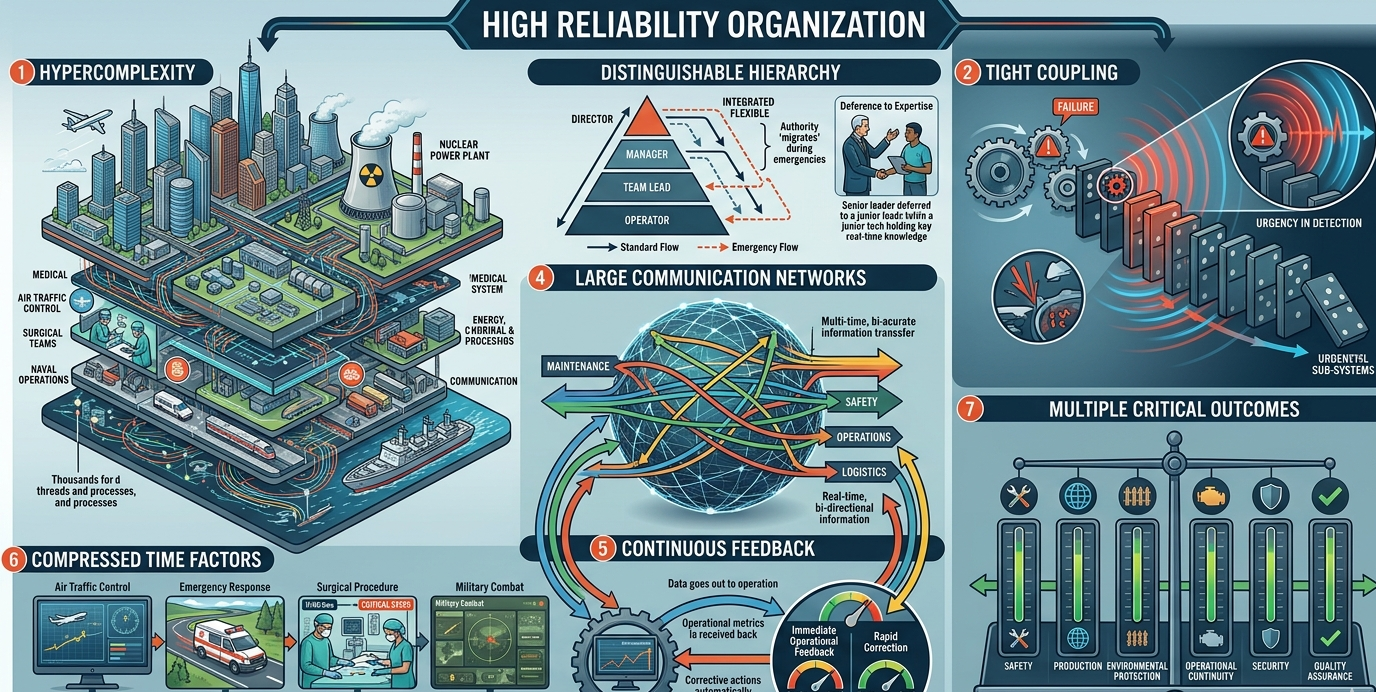
Hypercomplexity
HROs operate within extremely complex systems involving multiple interconnected components, technologies, departments, and operational layers.
Aviation systems, nuclear reactors, military operations, and healthcare systems all involve large numbers of interconnected activities that must function correctly at the same time.
Tight Coupling
Operations within HROs are closely linked together. A failure in one part of the system can quickly affect another part of the system.
This creates urgency in detecting and managing abnormalities before they escalate.
Distinguishable Hierarchy
HROs have structured organizational systems with clearly defined responsibilities, controls, and accountability mechanisms.
Although authority structures exist, flexibility is maintained during emergencies.
Large Communication Networks
High Reliability Organizations depend heavily on communication systems that ensure information flows rapidly and accurately across departments and operational levels.
Continuous Feedback
HROs receive immediate operational feedback about decisions, system conditions, and process performance.
This allows rapid correction of deviations and emerging risks.
Compressed Time Factors
Many HRO environments require decisions within seconds or minutes.
Examples include:
🔹 Air traffic control
🔹 Emergency response
🔹 Firefighting operations
🔹 Surgical procedures
🔹 Military combat situations
Multiple Critical Outcomes
HROs often manage several critical objectives simultaneously such as:
🔹 Safety
🔹 Production
🔹 Environmental protection
🔹 Operational continuity
🔹 Security
🔹 Quality assurance
Failure in any area can have severe consequences.
Major Disaster Case Studies That Influenced HRO Research
Several catastrophic incidents helped shape High Reliability Organization theory and highlighted the importance of organizational reliability.
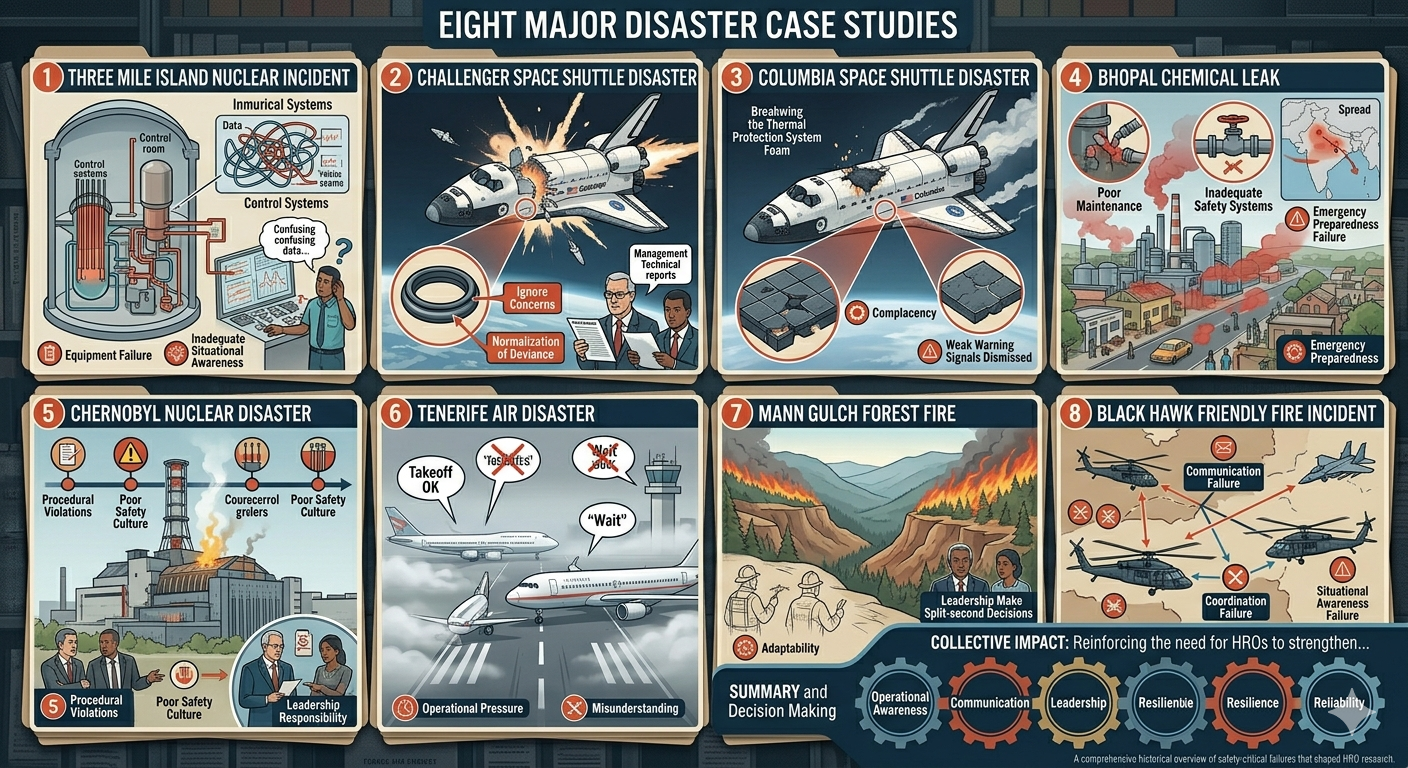
Three Mile Island Nuclear Incident
The Three Mile Island nuclear accident in 1979 exposed failures involving equipment malfunction, poor operator understanding, and ineffective communication.
The incident demonstrated how complexity and inadequate situational awareness could escalate operational problems.
Challenger Space Shuttle Disaster
The Challenger disaster in 1986 resulted from technical concerns being ignored under organizational pressure.
Warnings about faulty O ring performance were not adequately addressed before launch.
This disaster highlighted the dangers of poor communication, normalization of deviance, and management decision failures.
Columbia Space Shuttle Disaster
The Columbia disaster in 2003 reinforced lessons from Challenger.
Foam damage concerns during launch were underestimated, demonstrating how organizations can become complacent and dismiss weak warning signals.
Bhopal Chemical Leak
The Bhopal disaster in India remains one of the world’s deadliest industrial accidents.
Poor maintenance, inadequate safety systems, weak emergency preparedness, and ineffective management contributed to catastrophic toxic gas release.
Chernobyl Nuclear Disaster
The Chernobyl disaster illustrated how poor safety culture, procedural violations, inadequate reactor design, and leadership failures can combine to create catastrophic outcomes.
Tenerife Air Disaster
The Tenerife airport collision remains one of the deadliest aviation disasters in history.
Communication failures, operational pressure, and misunderstandings between flight crews and air traffic control contributed to the accident.
Mann Gulch Forest Fire
This wildfire tragedy highlighted the importance of leadership, adaptability, teamwork, and decision making during rapidly changing emergency conditions.
Black Hawk Friendly Fire Incident
The Black Hawk incident in Iraq demonstrated failures involving identification systems, communication, coordination, and situational awareness during military operations.
These disasters collectively reinforced the need for organizations to strengthen operational awareness, communication, leadership, resilience, and reliability.
The Five Core Principles of High Reliability Organizations
1. Preoccupation with Failure
High Reliability Organizations constantly focus on the possibility of failure.
They do not assume that success means safety.
Instead, they understand that small failures, near misses, process deviations, and weak warning signs may indicate deeper organizational vulnerabilities.
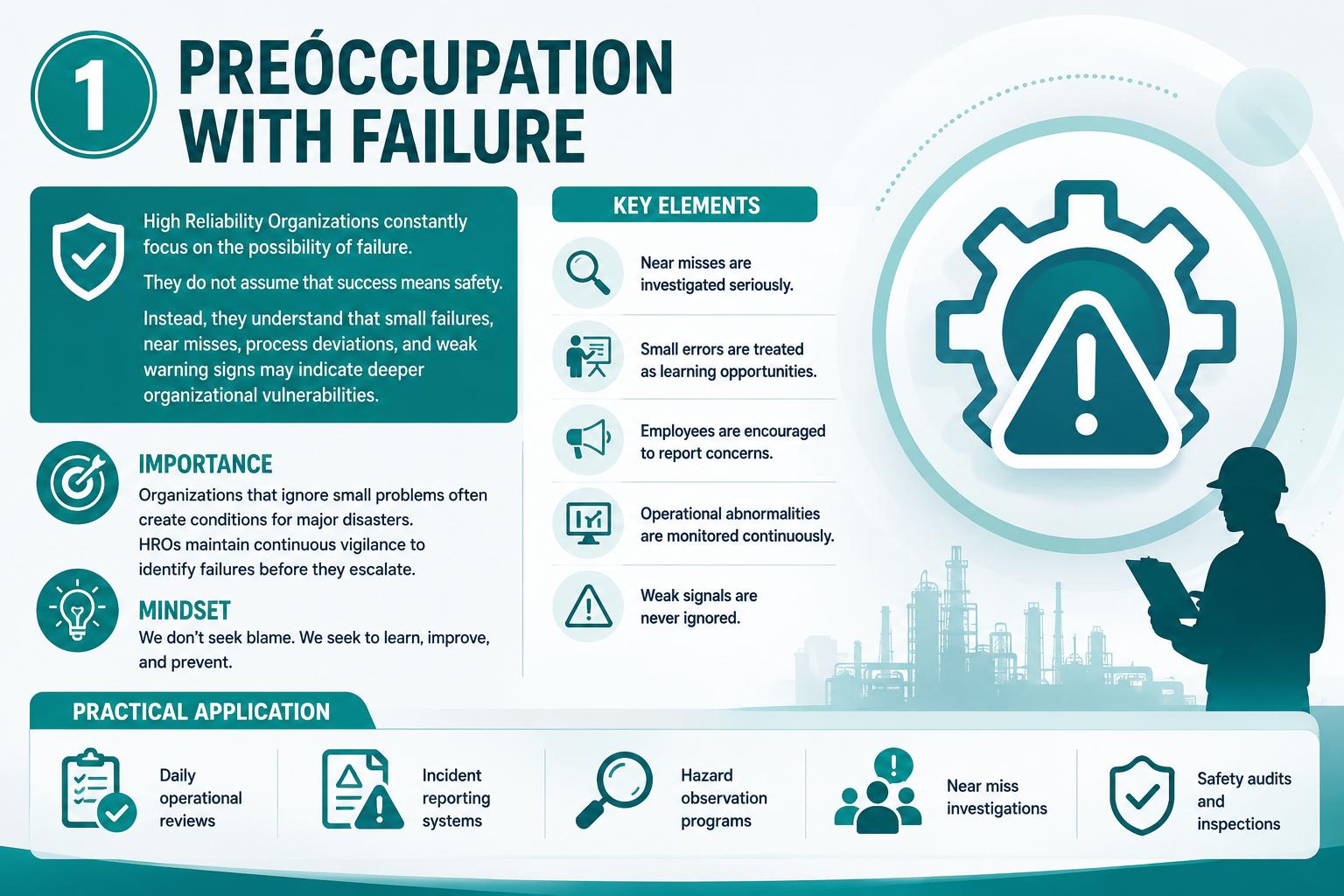
Key Elements
🔹 Near misses are investigated seriously
🔹 Small errors are treated as learning opportunities
🔹 Employees are encouraged to report concerns
🔹 Operational abnormalities are monitored continuously
🔹 Weak signals are never ignored
Importance
Organizations that ignore small problems often create conditions for major disasters.
HROs maintain continuous vigilance to identify failures before they escalate.
Practical Application
Examples include:
🔹 Daily operational reviews
🔹 Incident reporting systems
🔹 Hazard observation programs
🔹 Near miss investigations
🔹 Safety audits and inspections
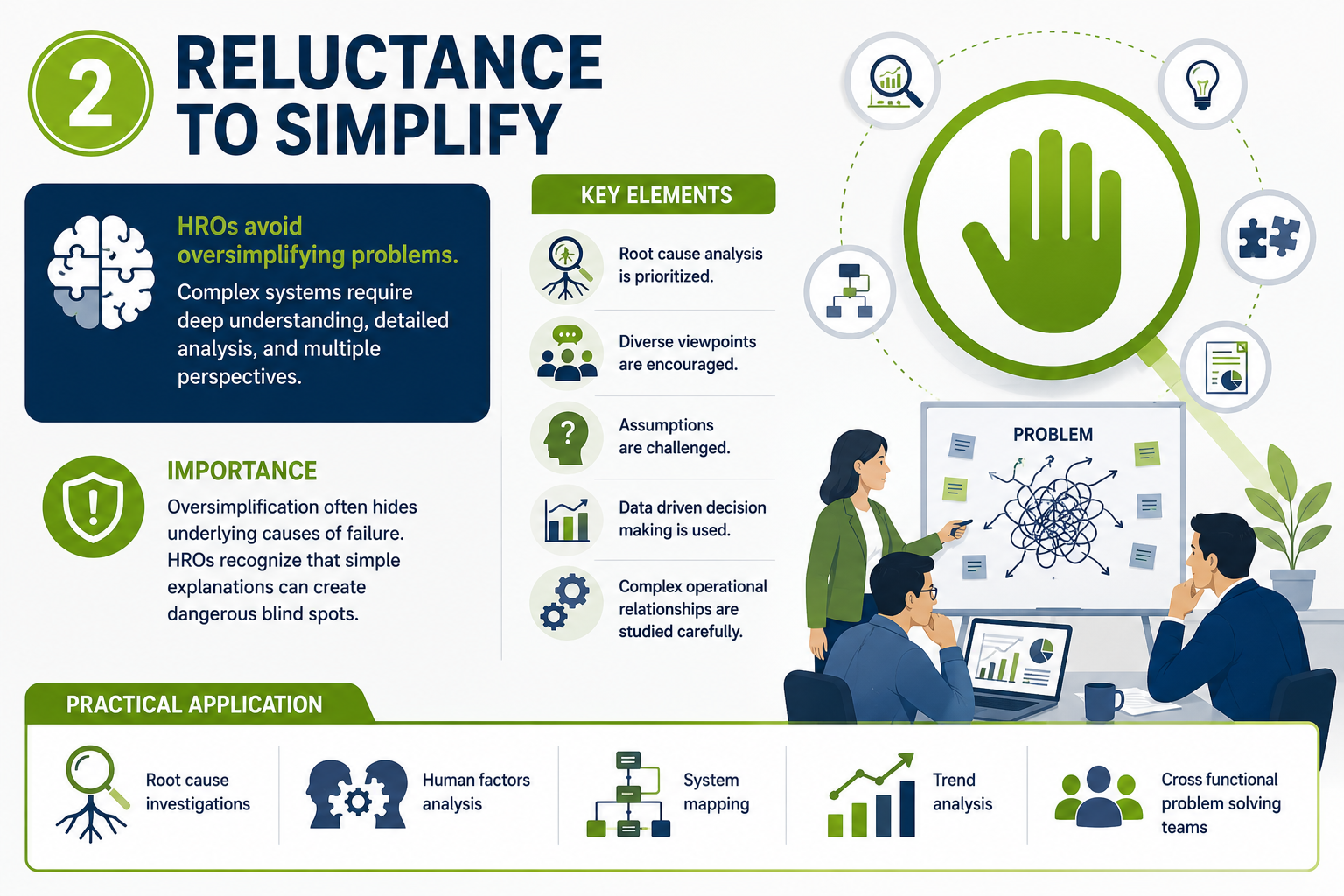
2. Reluctance to Simplify
HROs avoid oversimplifying problems.
Complex systems require deep understanding, detailed analysis, and multiple perspectives.
Key Elements
🔹 Root cause analysis is prioritized
🔹 Diverse viewpoints are encouraged
🔹 Assumptions are challenged
🔹 Data driven decision making is used
🔹 Complex operational relationships are studied carefully
Importance
Oversimplification often hides underlying causes of failure.
HROs recognize that simple explanations can create dangerous blind spots.
Practical Application
Organizations apply:
🔹 Root cause investigations
🔹 Human factors analysis
🔹 System mapping
🔹 Trend analysis
🔹 Cross functional problem solving teams
3. Sensitivity to Operations
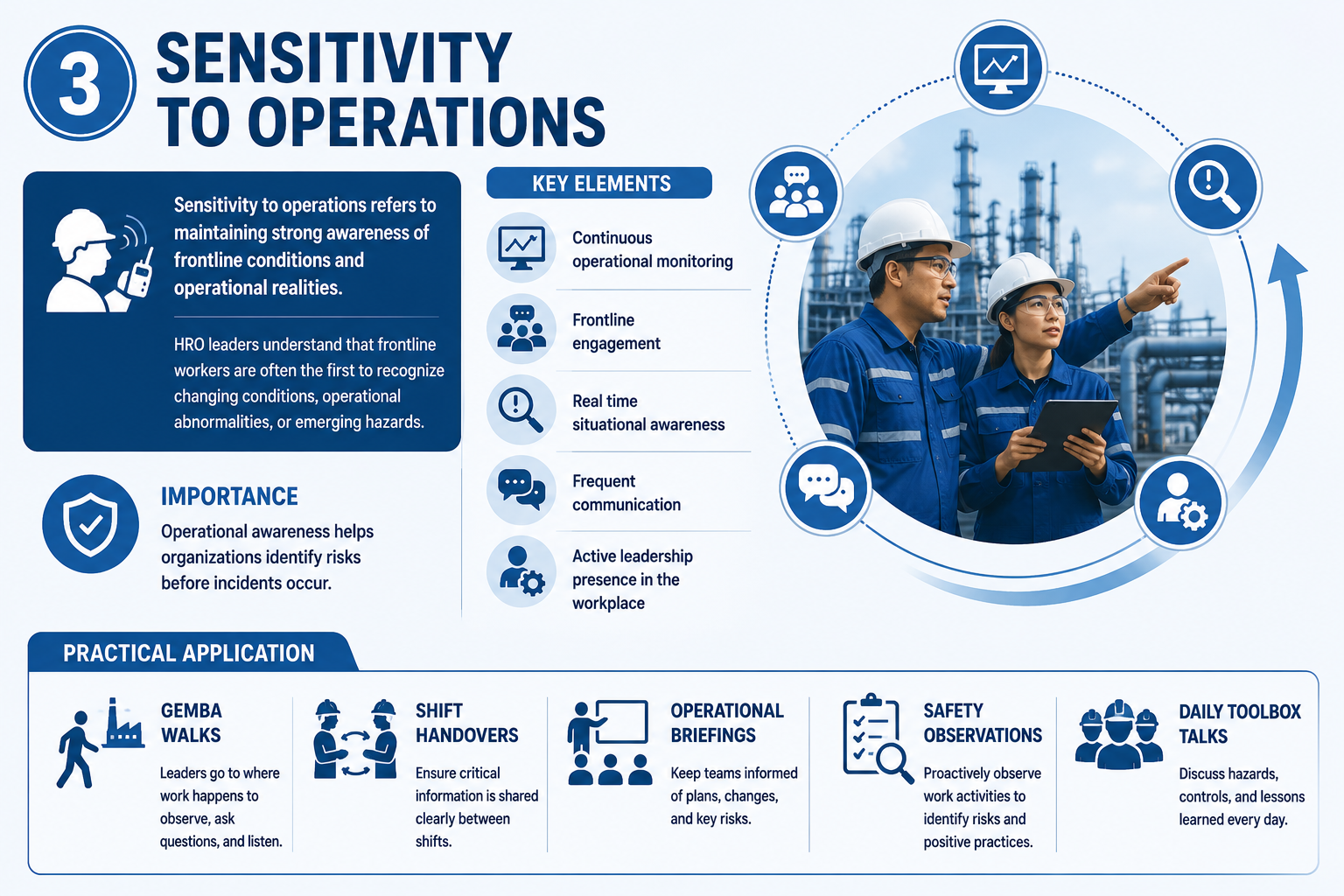
Sensitivity to operations refers to maintaining strong awareness of frontline conditions and operational realities.
HRO leaders understand that frontline workers are often the first to recognize changing conditions, operational abnormalities, or emerging hazards.
Key Elements
🔹 Continuous operational monitoring
🔹 Frontline engagement
🔹 Real time situational awareness
🔹 Frequent communication
🔹 Active leadership presence in the workplace
Importance
Operational awareness helps organizations identify risks before incidents occur.
Practical Application
Examples include:
🔹 Gemba Walks
🔹 Shift handovers
🔹 Operational briefings
🔹 Safety observations
🔹 Daily toolbox talks
4. Commitment to Resilience
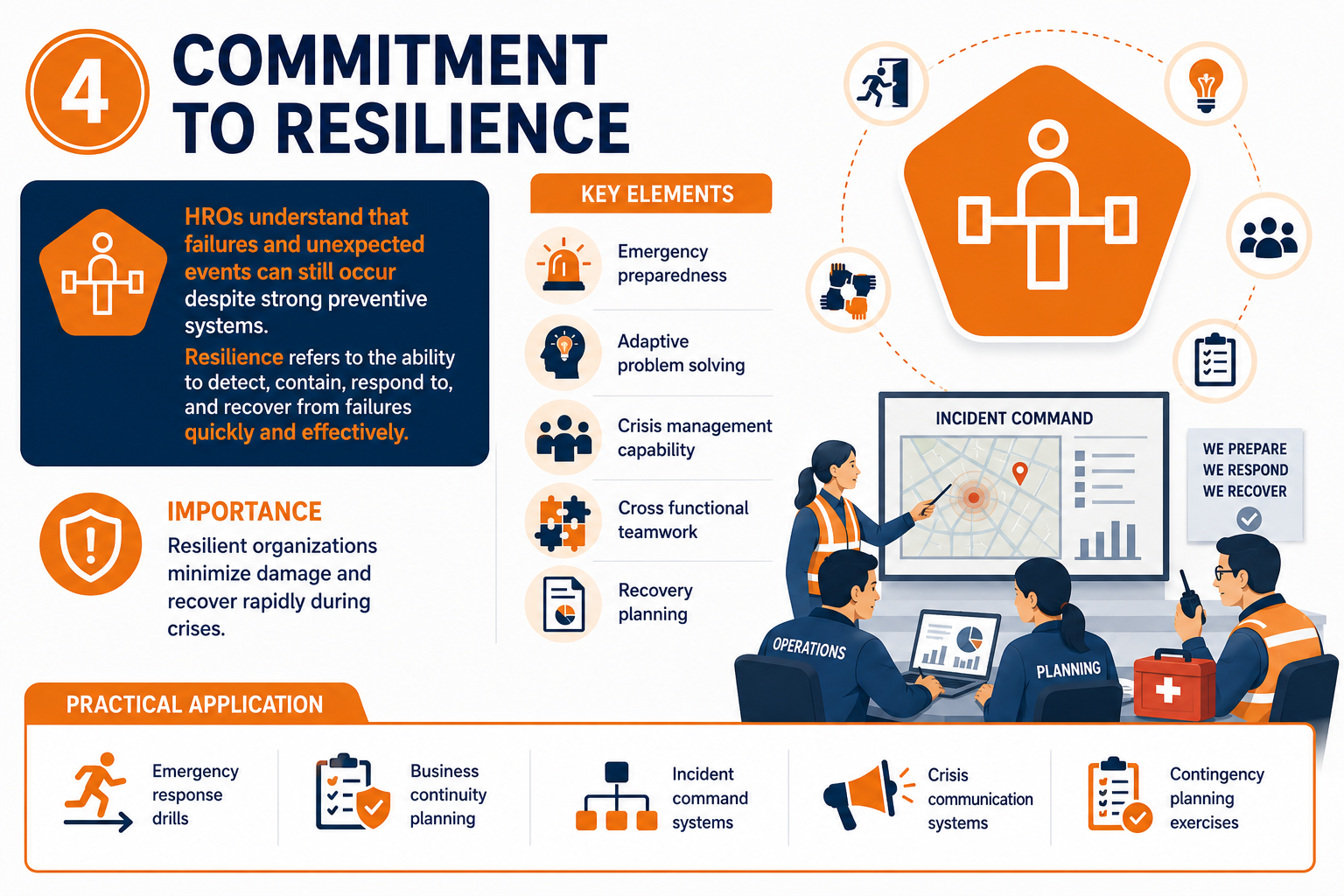
HROs understand that failures and unexpected events can still occur despite strong preventive systems.
Resilience refers to the ability to detect, contain, respond to, and recover from failures quickly and effectively.
Key Elements
🔹 Emergency preparedness
🔹 Adaptive problem solving
🔹 Crisis management capability
🔹 Cross functional teamwork
🔹 Recovery planning
Importance
Resilient organizations minimize damage and recover rapidly during crises.
Practical Application
Examples include:
🔹 Emergency response drills
🔹 Business continuity planning
🔹 Incident command systems
🔹 Crisis communication systems
🔹 Contingency planning exercises
5. Deference to Expertise
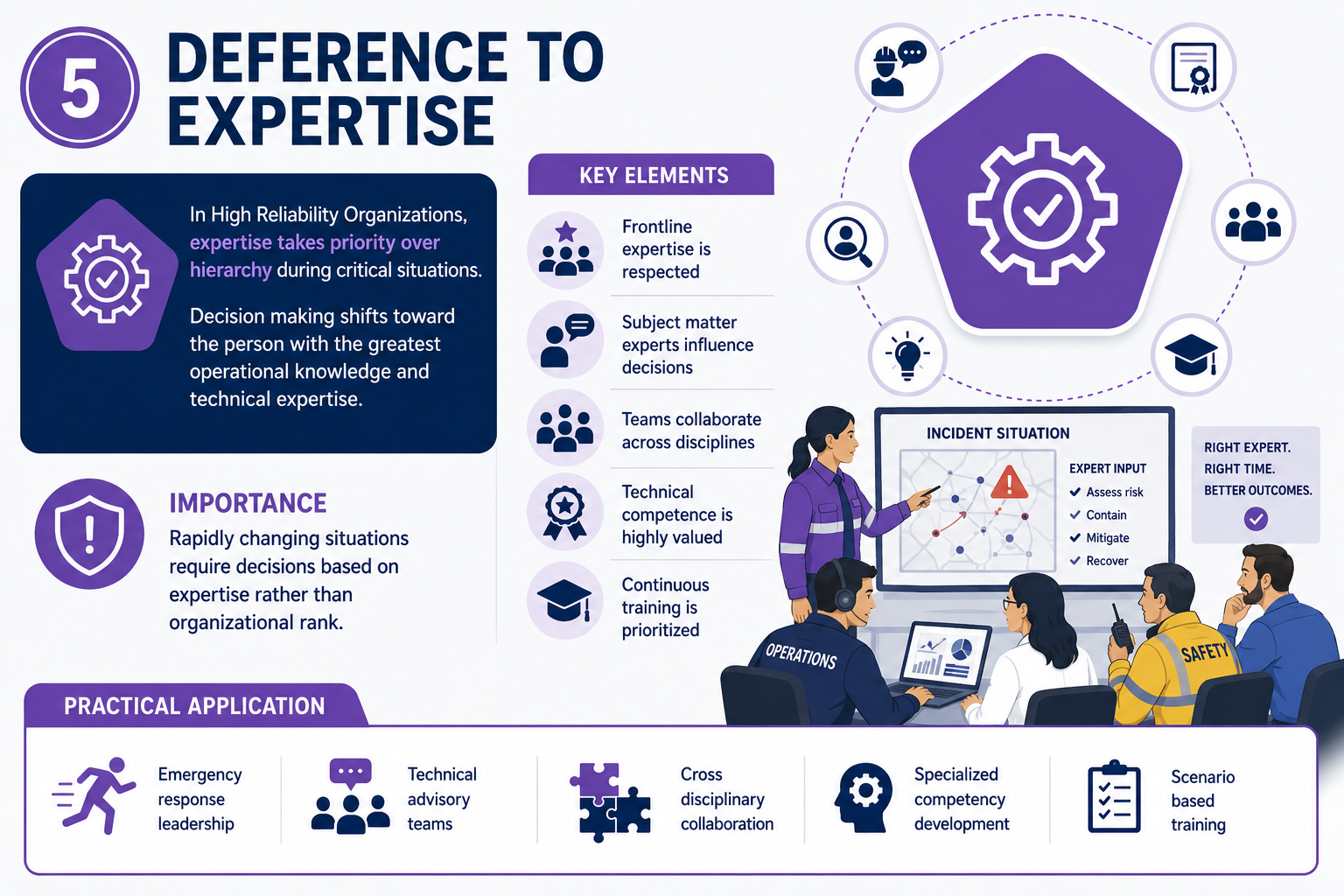
In High Reliability Organizations, expertise takes priority over hierarchy during critical situations.
Decision making shifts toward the person with the greatest operational knowledge and technical expertise.
Key Elements
🔹 Frontline expertise is respected
🔹 Subject matter experts influence decisions
🔹 Teams collaborate across disciplines
🔹 Technical competence is highly valued
🔹 Continuous training is prioritized
Importance
Rapidly changing situations require decisions based on expertise rather than organizational rank.
Practical Application
Examples include:
🔹 Emergency response leadership
🔹 Technical advisory teams
🔹 Cross disciplinary collaboration
🔹 Specialized competency development
🔹 Scenario based training
Mindful Organizing in HROs
Researchers Karl Weick and Kathleen Sutcliffe introduced the concept of mindful organizing as a foundation of High Reliability Organizations.
Mindful organizing refers to collective awareness and continuous attention to operational conditions, emerging risks, and system performance.
Mindful organizations continuously:
🔹 Observe operations carefully
🔹 Question assumptions
🔹 Share information openly
🔹 Learn from mistakes
🔹 Adapt to changing conditions
Mindfulness strengthens organizational alertness and improves the ability to detect subtle warning signs before incidents occur.
Applications of High Reliability Organizations
Although HRO theory originally focused on high risk industries, its principles are now applied across many sectors.
Healthcare
Hospitals apply HRO principles to reduce medical errors, improve patient safety, and strengthen communication during clinical operations.
Aviation
Commercial aviation uses HRO principles through crew resource management, standardized communication, and operational discipline.
Emergency Response
Firefighting organizations and incident command systems rely heavily on HRO concepts during emergency management.
Oil and Gas
Oil and gas operations use HRO principles to manage major accident hazards and operational risks.
Nuclear Power
Nuclear facilities maintain strict reliability systems due to the severe consequences of operational failures.
Military Operations
Military organizations apply HRO principles in combat operations, logistics, aviation, and crisis response environments.
Challenges in Becoming a High Reliability Organization
Becoming an HRO is not easy.
Organizations often struggle with:
🔹 Poor communication culture
🔹 Fear of reporting incidents
🔹 Production pressure
🔹 Leadership complacency
🔹 Weak accountability systems
🔹 Inadequate learning processes
🔹 Insufficient training
🔹 Resistance to change
Developing high reliability requires long term commitment from leadership and active participation from employees at every level.
Benefits of High Reliability Organizations
Organizations that adopt HRO principles often experience significant operational and safety improvements.
Improved Safety Performance
Strong reliability systems reduce incidents, injuries, and catastrophic failures.
Better Operational Stability
HROs maintain more consistent operational performance.
Stronger Employee Engagement
Employees feel empowered to report concerns and contribute to improvement efforts.
Enhanced Organizational Learning
Continuous learning strengthens long term improvement.
Increased Public Trust
Reliable organizations build stronger reputations and stakeholder confidence.
Conclusion
High Reliability Organizations demonstrate that high risk operations can achieve exceptional safety and reliability through strong organizational culture, operational discipline, continuous learning, and collective mindfulness.
The five principles of High Reliability Organizations provide a practical framework for improving safety, strengthening resilience, enhancing operational awareness, and reducing catastrophic risk.
As industries continue to become more technologically advanced and operationally complex, the importance of High Reliability thinking will continue to grow.
Organizations that prioritize vigilance, expertise, communication, resilience, and continuous improvement are far better prepared to manage uncertainty, prevent disasters, and protect people, assets, operations, and the environment.